Showing posts with label Japan Festivals. Show all posts

15 August, 2012

Obon

I'm so excited for the Davao holidays! It's only a few days now. I want to take a rest from having many lessons especially this week. This week is the Obon holiday in Japan for most students so we get a lot of reservations.

Maybe I haven't talked much about Obon last year because I only knew it as a holiday for the dead, like Philippines' All Soul's Day on November 2. And basically, most of the practices are the same: go to the graves, bring food and flowers, light up some incenses, and offer some prayers.  So, recently, I knew that the Obon practices can vary from family to family. But here's the general idea that I learned from some of the students.

Usually, Obon runs for three days. In some prefectures, two days. One student said that it is from August 13-14. One also said that it is only on August 13-14. But it depends on the calendar. So in these days, families can go to the graves or their ancestral houses.

Usually, the first born son, in recent times daughters too as long as they're first borns, handle the commemoration of their dead on Obon. The first borns take care of the ancestral house, thus it leaves them with the responsibility of handling Obon preparations.

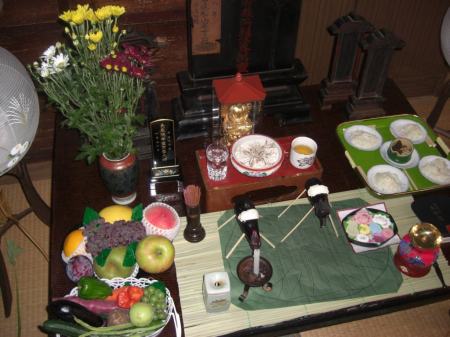
Some families prepare an altar of good things. Most importantly, they prepare some vegetables that they make into a horse and a cow. According to one of the students who make this practice, they use a cucumber to be made into a horse and an eggplant is made into a cow. The horse cucumber is the bringer of the souls of the dead. The horse fetches the dead on the first day. On the last day, which is the third day, of Obon, the souls of the dead will ride the eggplant cow. The cow sends them back to the underworld or the world of the dead. They also some incenses. This is to help the souls find their way to their ancestral houses. Favorite foods and fruits of the dead are also put on the altar.

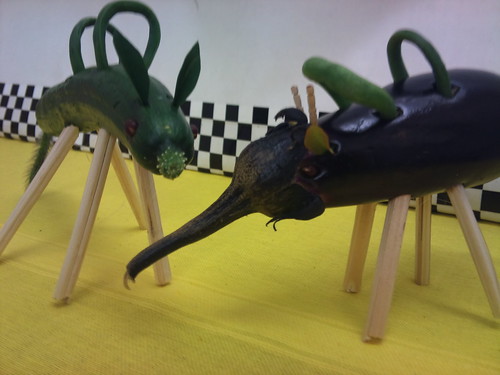
Cucuber horse and eggplant cow.

A Traditional Obon Altar

In general, Obon is a reunion time for most families. Many workers from big cities are given a chance to spend a week or two for holidays. Unfortunately for some, they don't have any Obon vacation but they can take a summer vacation a week or after from the Obon week.

As a foreigner, I somehow look forward to Obon because I can hear interesting things about their culture and practice on this special day. I'm also interested with the special foods and their corresponding meanings. I like this Japanese holiday! Even if it means a busy schedule for us teachers. ^_^

Images were from Google Images...

07 July, 2012

Tanabata, Ochugen, And Oseibo.

July 7th is Tanabata Day in Japan. Happy Tanabata Day!

Tanabata is the day when the Cow Herder Star crosses the Milky Way to meet his love, Weaving Princess. This is also a day for children to write their wishes on a small strip of paper and hang it on bamboo trees.

I asked my students about it and they don't really celebrate it anymore 'cause it's for children (that's also because my students usually are adults). One student said, it's also the time when young people can dress in their nice yukata and stroll to some food stall set-up in parallel to the Tanabata Festival. One student also said that in malls there are some Tanabata decorations, like the bamboo, where people can hang their wishes. But basically, Tanabata is for children.


On the other note...

I also learned from another student about a time of gift-giving, which they call Ochugen and Oseibo. Both are terms for the culture of gift-giving in Japan. First comes Ochugen that happens in the early days of July and Oseibo in the early days of December. As per the student, there's no decided date for the gift-giving but it usually happens on the first days of the month. Such celebrations, of course, are signified by advertisements.

The student also mentioned that Ochugen and Oseibo are usually observed by adults who are married. They give presents to the important people in their lives who have helped them or played a great role in their lives. Aside from parents, it could be the relatives, teachers, bosses, or other important persons. Single and young people don't really storm in Ochugen or Oseibo areas, only adults he said.

There's no usual item to give on Ochugen or Oseibo because it depends on the favorite things or the things the receivers want to have. The student said that his wife usually gives an apron for his mother-in-law. This time, he said, he sent out some good beer to his relatives.


An insight...

It's interesting to know that there are festivals and celebrations in Japan that matter age. Tanabata for children, Ochugen and Oseibo for adults. I guess we don't really have that here. Maybe it's celebrated differently.

For example birthdays. For children birthday parties, there are games and a lot of children foods like sweets, ice cream etc. For adult birthday parties, there are drinking parties, alcohol, and maybe for the more older adults, healthy foods, I suppose. But there is always cake. So, in conclusion, even if birthdays are celebrated differently in the Philippines, birthdays are for children and for adults alike.

I guess Japanese celebrations and festivals are like a reminder of one's childhood and old age. The more  you age, the less happiness there is. But I don't know. This is the magic of the Japanese celebrations and festivals.

Once again Happy Tanabata~~~ And Ochugen! !^o^!


04 May, 2012

Bitter Sweet

Hi! Nice to see you again! Maybe you'd think that I have resigned from being an home-based English teacher or HBOET already. Fortunately, not yet. I'm still here! I have just been lazy or there isn't any news to share lately, good or bad. Well not today. :)

On the lighter note

So today is the second day of the second half of the Golden Week in Japan. The first half started last April 28th until April 30th. The second half started yesterday, May 3rd, until this Sunday. The Golden Week is a (sometimes) week long holiday in Japan because it consists of national holidays consecutively and sometimes happen in a week, including Saturday and Sunday. It's a good chance for Japanese to travel, relax, and take lessons on the Golden Week. It's a good chance for teachers too because there are a lot of reservation in these days.


On the darker one

I have lost another avid student again. He is a beginner student but has a great enthusiasm when learning English. He struggles sometimes when talking but he always say the English is a hobby for him and enjoys it. He was always kind of down during his last days in our online school. His last day in our online school was on the 30th (of April) and he said that he would be back after everything is fine.


The Golden Week is ending. A student leaves... and another student comes. Let me tell more about it soon. :) This is it for today.


14 February, 2012

A Different Valentine's Day

Happy Valentine's Day!

Valentine's Day in the Philippines is an important celebration of LOVE, LOVE, LOVE! Though it's not a national holiday, it's a day where people share or confess their love to their family, sweetheart, spouses, friends, and to people who they really care about. You will know everyone's at it because they will greet you "Happy Valentine's Day" or "Happy Hearts' Day" and other similar greetings. There are also many heart stuffs everywhere, not only in the malls and restaurants, you can also see them in some classrooms or offices. Radio stations and local TV channels also showcase Valentine greetings. It's not really big like Christmas or New Year, but because of LOVE, LOVE, LOVE, that's what it makes it BIG.

However, in Japan, it's quite different. I'm always excited to know how they celebrate holidays and events. That's why I would always ask students what they think about it or what they do during that day--just like what I did last Christmas and New Year. So for this time, the Valentine's Day.

Some students say that Valentine's Day is the day for young girls-- in elementary to high-school-- to confess their feelings to the guy who they like. And they wait for the response on White Day, which is on March 14th, which is a day for the guy's turn to return the chocolates that they received on Valentine's Day or to give a response to the confessed feelings of the girl. Sounds weird right? Why not respond to it on the same day?

I found an article from Japan Today's Lifestyle section that tells also about Valentine's Day in Japan. Let me write it for you here:

Lots of chocolate, but little love on Valentine’s Day in Japan

Ah, Valentine’s Day. That most romantic of times is just around the corner. That means roses and chocolates, right?

Wrong. Guys, take note. If you get lots of chocolates from women in your office on Valentine’s Day, don’t get the wrong idea. They don’t all love you. They might not even like you. It’s probably “giri-choco” (obligation chocolate), a custom that bemuses foreigners (and foreign media) each year at this time.

Love has very little to do with Valentine’s Day in Japan, and it’s been that way for a long time.

So who took the love out of the day?

The confectionery companies, of course. Morozoff reportedly introduced Valentine’s Day to Japan in 1936 and again in 1952, but Mary Chocolate claims to have got the ball rolling in 1958, which is the first time, according to the company, chocolate was sold in Japan for Valentine’s Day. The gifts were promoted as “lover’s day” treats at a counter in Isetan department store in Shinjuku. But marketers quickly realized that Japanese men did not have a tradition of giving chocolates to their sweethearts, so they hit upon the idea of promoting the day as an occasion when women could give chocolates to the men in their life.

But then they took it a step further. Since each customer buying chocolates for one boyfriend or husband wouldn’t result in many sales, they packaged Valentine’s Day as a way to show appreciation for all the men in a girl’s life, including male coworkers. Nowadays, it’s not unusual for some women to buy a small chocolate for each guy in her office.

However, love hasn’t been completely abandoned on Valentine’s Day. Besides “giri-choco,” there is “honmei-choco” for the real thing.

How popular is the custom, anyway? In 2010, online researcher Macromill polled working women on their attitudes toward giving chocolates. Of the 515 responses from Japanese women aged 20-39, 78% said they always buy chocolates for Valentine’s Day. Of them, 71% give chocolates to their husbands and/or boyfriends, 48% to their bosses, 44% to male family members and 37% to coworkers. The two most common reasons for continuing the custom of “giri-choco” were: “It contributes to smooth communication in the workplace” and “It will get me a better evaluation at the company.”

Now, lest you think all this is unfair for women, the marketing gurus, in all their wisdom, then came up with White Day on March 14 — meant to be an occasion when men reciprocate with something sweet. The origins of White Day are also open to debate, but the custom can be traced back to 1965, when it was introduced by a marshmallow manufacturing company to drive up sales of its sugary product. By the 1980s, white chocolates replaced marshmallows as the preferred gift, but since then, candy, flowers—even underwear—have become popular presents. Whatever the item, it is known in Japanese as “sanbai-gaeshi” (triple value) because it is supposed to be three times greater than the value of the chocolates the guy got on Valentine’s Day.

Whether it is “giri-choco or “honmei-choco,” Valentine’s Day is big business in Japan. According to the Chocolate & Cocoa Association of Japan, of the 406 billion in annual sales of chocolate in 2010, approximately 53% came during the month leading up to Feb 14. It is not unusual for confectionery companies to spend the bulk of their yearly marketing budget on Valentine’s Day.

Just as they do with Halloween and Christmas, retailers begin their Valentine’s merchandising campaigns well in advance, often in mid-January. From Feb 1 and even earlier, department stores, supermarkets and convenience stores set up huge red displays full of goodies. Some department stores, such as Takashimaya in Nihonbashi and Mitsukoshi in Ginza, for example, dedicate an entire floor to gift chocolates, with up to 50 brands represented. The stores predictably give their campaigns French names names like “Amour du Chocolat!” or “Mont d’Amour.”
In recent years, the European brands have conquered Japan. During their campaigns, department stores often bring the chocolate makers from Europe to be on hand to talk with shoppers and give chocolate-making demonstrations. Department stores also report that in recent years, there has been an increasing number of women who buy expensive chocolates for themselves, rather than for men.

http://www.japantoday.com/category/lifestyle/view/lots-of-chocolate-but-little-love-on-valentines-day-in-japan

From that article we would see a glimpse of the Japanese Valentine's Day. Not so romantic compared to here and more of an obligation for some. I asked some students if what day is romantic, they would say it's Christmas Day. I learned before (maybe I haven't talked about it last December) that Christmas Day is more of like a day for the couples, thus romance and sweetness is associated with that day and not so much on Valentine's Day.

Some curious students also asked me if we (Filipinos) celebrate Valentine's Day as a religious event. I told that though Valentine's Day is a commemoration of a saint we don't celebrate Valentine's Day as a religious event. It's a day where we commemorate the big L-O-V-E.

Others asked what would I do on this day or would I receive any thing special, I told them that I would just work, work, work, thus a normal day for me. LOL

I always have fun talking with students about events, especially about events that are differently celebrated in Japan. They give me a tour about Japan with their experiences, opinions, and their practices. They even give me more information compared to online encyclopedias and books. This is indeed one of the perks working as an HBOET.

I'm still in the middle of my shift. I still have four more lessons to go, that means four more students to torment with the Valentine fever in me. hehehe

Happy Valentine's Day again! XOXO

03 February, 2012

Setsubun

Today is Setsubun in Japan. It is a festival that marks the beginning of spring in the Japanese lunar calendar.

I don't know if Japanese still remember Setsubun as that. When I asked students about it they usually say they need to throw soy beans outside their houses to ward off the oni or demons. And they throw beans inside their houses to bring good luck inside. They also eat the same number of soybeans as their age. They say it'll bring you good luck. I'm still in the middle of my shift so I don't have the chance to ask a lot of students about Setsubun. To fill the gap, luckily, I found this article in Japan Today.

Chase the demons away with beans on Setsubun
By Yuko Watanabe

TOKYO —
Setsubun is the festival held on Feb 3, which traditionally marks the beginning of spring on the Japanese lunar calendar.

Temples and shrines across Japan stage various rituals at Setsubun, such as throwing beans, to drive away demons and bring happiness for the year. Some of the big shrines invite celebrities such as sumo wrestlers, actors and singers to throw beans at onlookers.

The men and women who throw the “fuku mame” (fortune beans) are called “Toshi-otoko” and “Toshi-onna,” and are selected based on their birth year according to the Chinese zodiac, so this year, anyone born in the year of the dragon has the right to throw beans at the festivals.

Usually, they throw roasted soy beans from the stage to the crowds who try to catch and eat them, believing that will bring happiness during the year. When throwing the beans, the people shout “Oniwa soto, fukuwa uchi” (Demons out! Good fortune in!). It is believed that eating the same number of the beans as one’s age is especially lucky.

Setsubun is not just for shrines; you can celebrate it at home as well. The father or the oldest man of the house plays the role of a demon with the mask, and the children throw beans at him, shouting “Oniwa soto, fukuwa uchi.”

Another traditional custom at Setsubun is eating “eho-maki,” which is a fortune sushi roll. It contains seven ingredients (dried ground shavings, cucumber, mushrooms, egg omelet, eel and pink colored fish powder), which represent the Seven Gods of Good Fortune.

When people eat the roll, they contemplate the lucky direction of the year ahead in silence, wishing for happiness. Eating the roll uncut signifies that your good relationships with others will not be cut. The lucky direction of this year is north-northwest.

Where to see Setsubun on Feb 3

1. Naritasan Shinshoji Temple/Bean-throwing at 11 a.m., 1:30 p.m. and 4 p.m.

2. Asakusa-dera Temple

3. Rinnou-ji Temple/Bean-throwing starts at 2:45 p.m.

4. Ikegami honmon-ji/Bean-throwing starts at 3 p.m.

5. Hase-dera/Bean-throwing starts at 12 noon.

6. Zojo-ji/Bean-throwing starts at 12:30 p.m.

7. Okunitama-jinja/Bean-throwing starts at 2 p.m., 4 p.m. and 6 p.m.

8. Toyokawa Inari Betsui-in/Bean-throwing starts at 2 p.m.

9. Inuyama Naritasan

10. Mamasan Guhouji/Bean-throwing starts at 2:30 p.m.
Taken from: Japan Today Lifestyle Section